
Automating EU VAT OSS in Your Billing System
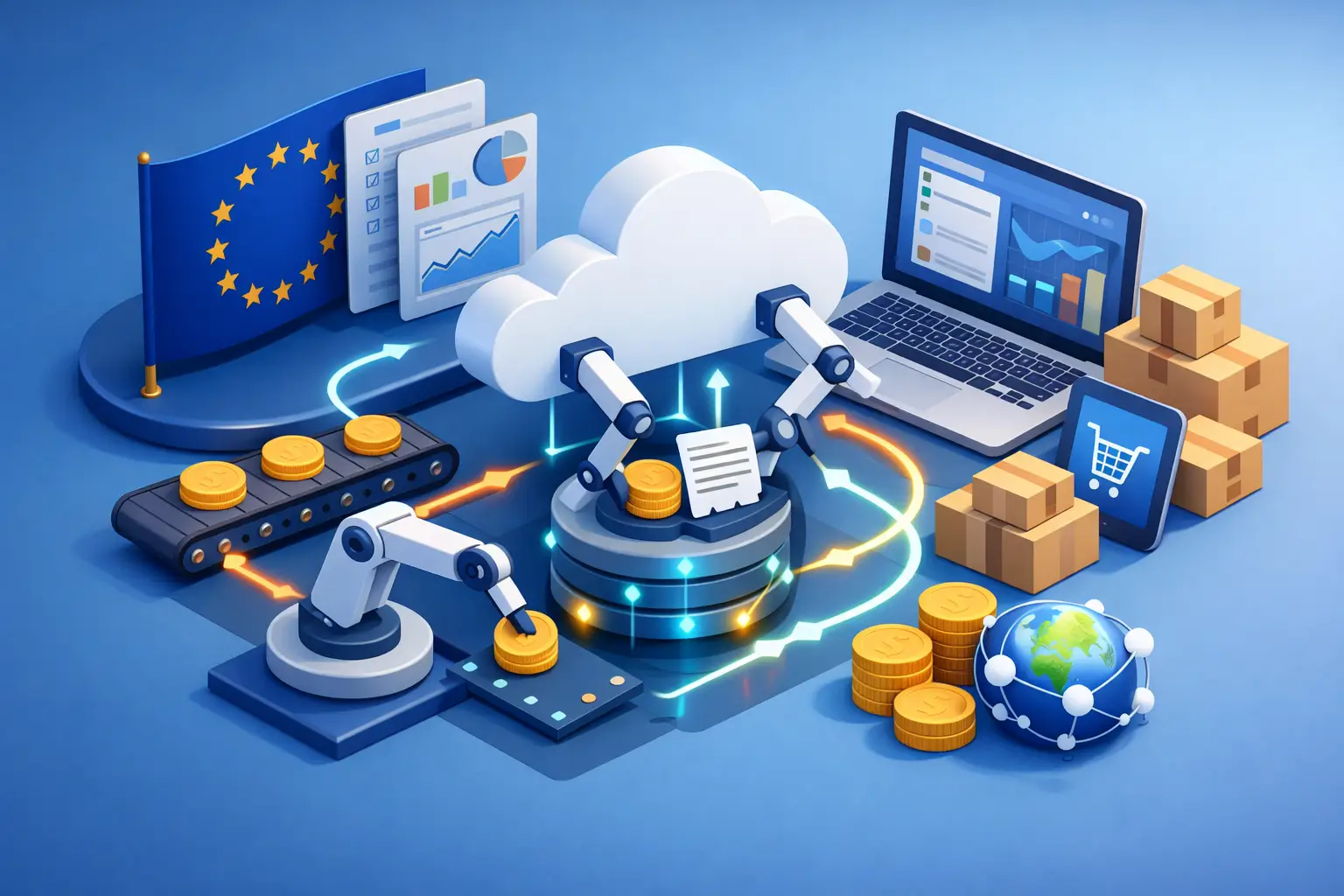
A new self-service customer in France signs up for an annual plan, adds seats three days later and receives a credit note in the same quarter. If these events live in separate systems for product, billing, payments and accounting, the One-Stop Shop (OSS) return quickly turns into a manual reconstruction job. Automating EU VAT OSS therefore starts long before the amounts are typed into a portal at the end of the quarter. At every billable event, the system has to capture the tax-relevant facts correctly, version them and keep them as evidence until the return is filed.
For European SaaS companies, OSS reaches well beyond a single tax feature. The process involves pricing, customer classification, invoice generation, payment status, refunds, the ledger and the month-end close. If you treat it as a downstream export, you end up building an Excel process on top of a fragmented billing architecture. That setup does not scale as you add countries or usage-based pricing.
What EU VAT OSS covers
The One-Stop Shop simplifies how VAT on certain cross-border B2C sales within the EU is declared and paid. A company established in Germany can report the VAT it owes in other member states centrally through the Federal Central Tax Office (BZSt), instead of registering separately in every country of consumption for those sales.
Digital businesses need to know exactly where OSS applies, because it is not the default treatment for every EU sale. B2B services to customers with a valid VAT ID (USt-IdNr.) typically fall under reverse charge and do not belong in the OSS return. Domestic B2C sales do not automatically go through the OSS process either. Special cases such as marketplace setups, services with a different place of supply or local registrations also need their own tax assessment.
So the question goes beyond which VAT rate applies in France. You need to know which tax role each customer has, where the place of supply is, which time of supply is relevant and which legal basis has to be documented on the invoice and in the ledger. If these decisions are missing from the data model, the quarterly return becomes unreliable, even when the final export looks formally correct.
Automating EU VAT OSS starts in the data model
A reliable workflow starts with clear customer segmentation. For every account, the billing system must distinguish between B2C, B2B with a validated VAT ID, B2B without a successful validation, and special tax cases. A free-text field is not enough for the VAT ID. The system has to store its validation status, the validation result, the time of the check and the country code used, so that each decision can be traced later.
For B2C digital services, the country of destination is the basis for taxation. Billing and the tax engine therefore need reliable evidence of where the customer is located. Depending on the case, the billing address, the country of payment, bank details, IP-based information or other permitted evidence can be relevant. Collecting as many data points as possible matters less than handling conflicting data in a controlled way and keeping a permanent record of the decision that was used.
Product classification comes next. A flat VAT rate per customer stops working as soon as the catalog contains different services, fees or add-ons that are taxed differently. The tax classification must be tied to the product, the price version and the billing event. When a plan changes, the tax logic must not be carried over silently from an old configuration.
Usage-based billing adds another layer: the time of supply and the allocation to periods have to be unambiguous. If usage is billed at the end of the month, the relevant revenue can come from a large number of usage events. Duplicate events, late corrections or aggregations that cannot be reproduced then lead to wrong invoices and also to a wrong tax base. That makes idempotent event ingestion and versioned pricing rules tax controls as well.
The flow from checkout to the OSS return file
Automation works when operational statuses and financial data stay connected in one continuous chain. At checkout, or when a customer account is created, the system records the country, the customer type and the VAT ID. The tax decision is calculated before invoicing, so accounting does not have to correct it afterward. The invoice shows the correct rate, the VAT amount, the service period and, for B2B cases, the reverse charge note.
Once the invoice is created, the system needs to keep the tax-relevant data in a ledger that is immutable but correctable. Errors still get corrected, but each cancellation, credit note or additional charge appears as its own traceable transaction, with a reference to the original document, the original country of supply and the correct tax effect.
For the OSS report, the ledger entries are aggregated by reporting period, country of consumption, VAT rate and type of sale. Drafts, voided invoices and purely technical payment events must not be counted as taxable sales by mistake. You also need a clear definition of whether the internal logic evaluates by invoice date, by service period or by another timeline that tax rules prescribe. That rule belongs in the configuration and the audit documentation, and it should not be left to a formula at the end of an Excel tab.
In a good setup, finance gets more than a CSV file. It gets the taxable amount and the VAT for each country and rate, can trace any discrepancy back to the individual invoice line and records corrections in the correct period. Engineering keeps an API that makes tax decisions, price versions and event references reproducible. Kontier connects this flow, from the product catalog and the usage event to the invoice, the ledger and usable return data, in one European compliance architecture.
Mistakes that make quarterly returns expensive
The most common mistake is to treat the billing country as the tax country. A German billing address can be an indication, but it does not replace a reliable determination of the place of supply. Conversely, the payment provider must not become the only source of the tax decision when its data does not match the customer evidence.
Second, VIES checks are built into the billing flow too late or not at all. If a VAT ID is only validated after invoicing, you get avoidable corrective invoices and open questions about the tax treatment. A clear state machine works better: until validation succeeds, the account is not eligible for reverse charge. If the number is missing or invalid, defined tax rules apply instead of manual exceptions.
Third, refunds are treated as a pure payment operation. A refund can represent a credit note, a partial reduction of the contract or the fix for a billing error. Each of these has different references and must be modeled cleanly in the tax and ledger logic. If you only export a negative payment amount, you lose the link to the underlying service.
Fourth, price changes collide with historical tax data. New pricing must not revalue earlier periods, so every invoice needs a snapshot of the product, price, tax classification, customer data and calculation rule. Changing prices without a deploy is only an advantage if past billing can still be reproduced exactly as it was.
Controls instead of a quarter-end rush
The best automation reduces data entry and also makes errors visible before a return is filed. That calls for checks on missing country information, B2B accounts without a successful VIES validation, negative VAT amounts without a credit note reference, invoices without a tax code, and differences between the invoice ledger and the OSS aggregation.
Finance also needs a close process with clear status boundaries. Events can enter the period up to a defined cut-off. Anything that arrives later is treated as a correction, which keeps it traceable why the tax base for a country has changed. The month-end close then becomes a controlled reconciliation of one shared data set, and nobody has to hunt for differences between the Stripe export, the billing report and the accounting records.
Access rights are part of the design too. Product teams can configure prices and promotions, but they cannot overwrite tax classifications retroactively. Finance can approve exceptions and close reporting periods. Engineering runs the integration through versioned APIs and gets clear error signals, for example when a usage event references a plan without a tax classification.
When OSS automation gets demanding
For a simple monthly B2C plan sold in a few countries, a lean process may be enough at first. Complexity jumps once you add multiple price versions, annual prepayments, usage-based fees, mid-period upgrades or hybrid B2B and B2C sales channels. At that point the unit that matters shifts from the customer to the individual line item in its historical context.
Cases where a customer switches from B2C to B2B, submits a VAT ID later or changes its place of establishment also need close attention. Automation must not hide them. It has to record each one as a change in tax status with an effective date, so that future billing, and any billing that may need correcting, stays under control.
The right target architecture therefore produces more than an OSS report. It creates an auditable chain from the product price through the customer evidence and the invoice to the tax entry in the ledger and the quarterly return. With that chain in place, the next Excel close no longer sets the limits of your European expansion; the limits come from decisions your product team can make deliberately.